
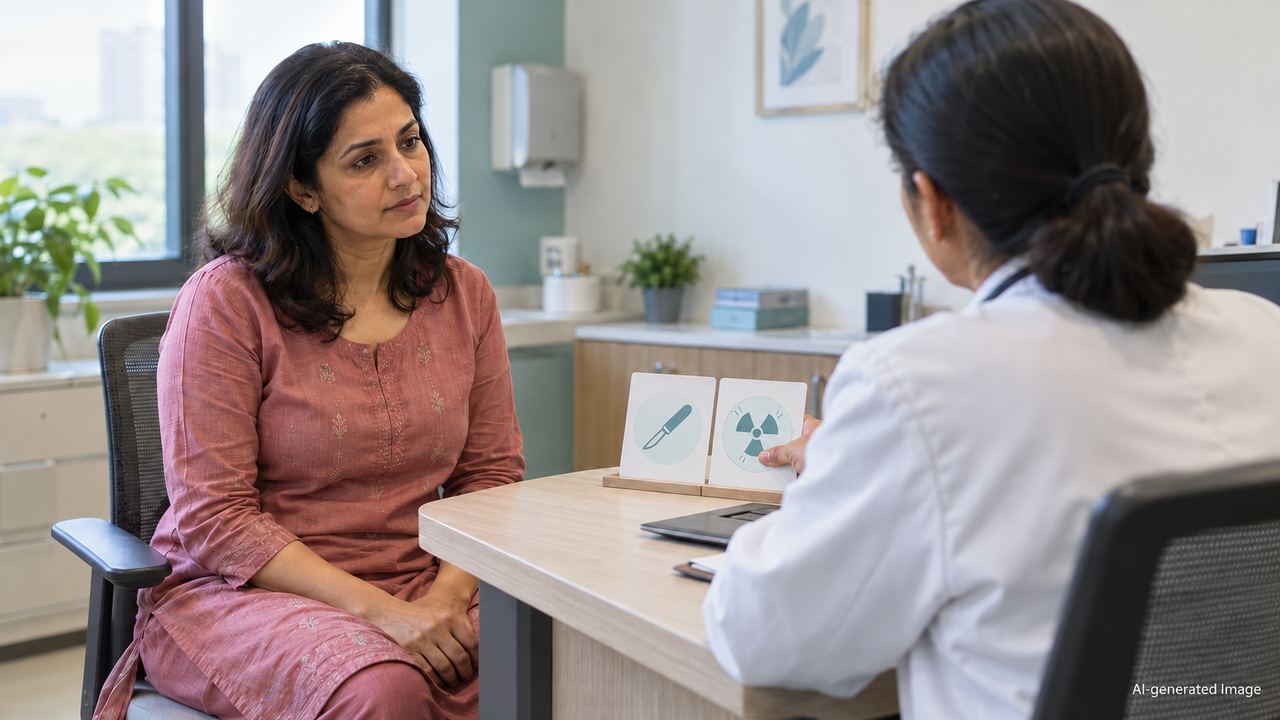
Imagine being diagnosed with early-stage breast cancer and being told that two surgical options may be suitable. One removes the tumour while preserving most of the breast; the other removes the entire breast. Naturally, questions about survival, recurrence, recovery and appearance begin to surface. As a radiation oncologist providing care for breast cancer, I understand how difficult this decision can feel for patients and their families.
The choice between lumpectomy with radiation and mastectomy depends on more than the extent of surgery. Let us explore how the procedures in question differ, what research says about survival, which factors matter when choosing a treatment plan, and how a radiation oncologist can help!
What is the Difference Between Lumpectomy and Mastectomy?
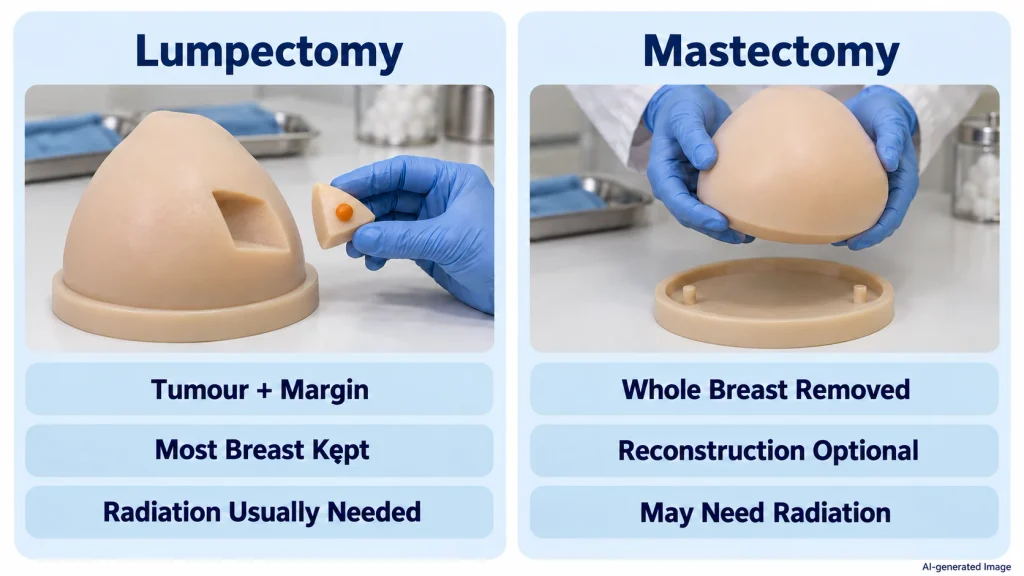
The main difference between lumpectomy and mastectomy is how much breast tissue is removed. A lumpectomy removes the cancer along with a margin of surrounding healthy tissue, while a mastectomy removes the entire breast. Either procedure may also require examination or removal of nearby lymph nodes, depending on the case.
What Happens in a Lumpectomy?
Lumpectomy, also called breast-conserving surgery, aims to remove the tumour while preserving most of the breast. It is often followed by radiation therapy to reduce the risk of cancer returning in the same breast.
What Happens in a Mastectomy?
Mastectomy involves removing the entire breast containing the cancer. Surgeons may perform breast reconstruction during the same operation or at a later date. Although mastectomy removes more breast tissue, it does not automatically eliminate the need for radiation.
Why Does Lumpectomy Need Radiation Therapy?
After surgery, microscopic cancer cells may remain in the surrounding breast tissue, even after the visible tumour is removed. Radiation after lumpectomy helps destroy these cells and lowers the risk of local recurrence. The treatment plan depends on tumour characteristics, surgical margins, lymph node involvement and other risk factors.
A common question is, "Do I need radiation after lumpectomy?" Most patients do, although some may be suitable to omit radiation after careful assessment. External radiation treatment itself is painless. Depending on the prescribed schedule, treatment may take around one week to several weeks, with many patients receiving three to four weeks of treatment.
Is Survival the Same After Lumpectomy with Radiation and Mastectomy?
For suitable patients with early-stage breast cancer, research shows that breast-conserving surgery followed by radiation offers survival outcomes comparable to mastectomy. Therefore, lumpectomy with radiation vs. mastectomy is not simply a choice between a smaller operation and a more extensive one. Both can be effective when appropriately selected.
When patients search for the mastectomy vs lumpectomy survival rate, the key point is that removing the entire breast does not necessarily improve survival. The appropriate choice depends on the cancer, treatment suitability and personal preferences. Surgery and radiation are only parts of the wider breast cancer treatment options early-stage patients may consider.
What Are the Risks of Recurrence with Each Option?
Cancer can return after either operation. Following lumpectomy and radiation, the cancer may recur in the treated breast. After mastectomy, recurrence can still occur in the chest wall or nearby tissues because not every breast cell can be removed.
The National Cancer Institute reports that around 5–10% of women treated with lumpectomy and radiation develop cancer in the same breast within 12 years, compared with approximately 1 in 20 women experiencing recurrence on the same side after mastectomy. These are general estimates, not individual predictions; personal risk varies with the cancer and treatment received.
How Do Recovery, Side Effects and Daily Life Compare?
Recovery depends on the operation, the need for reconstruction and the patient's general health. Lumpectomy generally involves a shorter recovery, while mastectomy, particularly with reconstruction, may require more time.
Recovery After Surgery
Many patients return to usual activities within about two weeks after lumpectomy, while mastectomy recovery may take three to four weeks or longer. Reconstruction can extend recovery further. Individual recovery times vary.
Common Radiation Side Effects

The main breast cancer radiation side effects include:
- Redness, dryness, or darkening of the skin
- Breast tenderness or swelling
- Fatigue that may build up during treatment
These effects vary between patients and are often temporary. Contact the treatment team if symptoms become severe, worsen unexpectedly or interfere with daily activities.
Does Mastectomy Always Avoid Radiation?
No. Radiation may still be recommended after mastectomy, particularly when cancer involves lymph nodes, the tumour is large, or cancer cells are present at certain surgical margins. The final recommendation depends on the pathology report and overall risk assessment.
| Factor | Lumpectomy with radiation | Mastectomy |
| Surgery | Tumour and surrounding tissue removed | Entire breast removed |
| Radiation | Usually recommended | May still be needed |
| Treatment duration | Surgery followed by radiation when indicated | Surgery, with additional treatment if required |
| Breast appearance | Most breast tissue preserved; shape may change | Breast removed; reconstruction is optional |
| Recovery | Generally shorter | May take longer, especially with reconstruction |
| Follow-up | Regular examinations and breast imaging | Regular follow-up; imaging depends on the situation |
How Does Each Option Affect Body Image and Reconstruction?
Breast surgery can affect body image, confidence and intimacy. While some women prefer to preserve their breasts, others choose mastectomy, with options such as reconstruction, an external prosthesis or remaining flat. Lumpectomy can also change breast shape, so discussing personal preferences with the care team before surgery is important.
Who May Not Be a Good Candidate for Lumpectomy?
Lumpectomy may not be suitable when:
- Cancer is present in several separate areas of the breast.
- The tumour is large relative to breast size.
- Previous chest radiation limits further treatment.
- Radiation cannot be given safely, such as during certain stages of pregnancy.
- Genetic risk, other medical factors or personal preferences favour mastectomy.
A BRCA mutation does not automatically mean mastectomy is necessary. Genetic counselling and discussion with the breast cancer team can help clarify the options.
What Questions Should a Patient Ask a Doctor Before Deciding?
Before choosing between breast-conserving surgery vs. mastectomy, consider asking:
- Is either operation more suitable for my cancer?
- Will I need radiation, and for how long?
- What is my individual risk of recurrence?
- How might each option affect breast appearance and sensation?
- Could I need chemotherapy or hormone therapy?
- What reconstruction options are available?
- Would a second opinion help me feel more confident?
How Can a Radiation Oncologist Help You Decide?
As a breast cancer doctor in Kolkata, I help patients understand the role of radiation in their overall treatment plan, including its benefits, limitations, side effects and expected schedule. I also explain when radiation may be recommended after lumpectomy or mastectomy. The final surgical decision should be made in discussion with the breast surgeon and wider cancer care team.
Patients seeking guidance can contact us to discuss radiation therapy and personalised treatment planning. This article offers general information and does not replace an individual medical assessment.
What People Also Ask
Which is better, Lumpectomy or Mastectomy?
Neither is universally better. For suitable early-stage cancers, lumpectomy with radiation can offer survival outcomes comparable to mastectomy.
Do we need radiation after a Lumpectomy?
Radiation is usually recommended, although selected patients may be eligible to omit it after specialist assessment.
Can a patient avoid radiation after choosing a Mastectomy?
Sometimes, but radiation may still be required depending on tumour size, lymph node involvement and other findings.
Is the survival rate the same for both?
For suitable patients with early-stage breast cancer, long-term research shows comparable survival outcomes.
Is cancer more likely to come back after Lumpectomy?
Local recurrence may be more likely after lumpectomy, but radiation reduces this risk. Individual estimates vary.
How long does radiation take after a Lumpectomy?
Many courses last three to four weeks, although some are shorter and others longer.
Is radiation therapy painful?
The external radiation session itself is painless, although skin irritation and fatigue may develop during treatment.
Will a breast look normal after Lumpectomy and radiation?
The breast is preserved, but scarring, changes in size or firmness, and skin changes may occur.