

Bleeding after menopause is never “just hormonal” and never something to watch quietly. For many women, it is the earliest alarm bell of uterine disease, including cancer.
Consulting an experienced uterine cancer doctor in Kolkata at the first sign of abnormal bleeding can mean the difference between early treatment and a delayed crisis.
This guide explains exactly why post-menopausal bleeding demands attention, what it signals, and what your next step should be.
Postmenopausal Bleeding: Why It Requires Medical Attention
Bleeding after menopause is abnormal because the uterine lining should be inactive. Any bleeding indicates structural, hormonal, or malignant pathology that requires evaluation.
Menopause marks the end of the monthly growth of the uterine lining. Once periods stop for 12 consecutive months, the uterus should remain quiet. Bleeding beyond this point is not a delayed period, stress response, or dietary issue.
Doctors treat postmenopausal bleeding as a red-alert symptom
That’s because:
- The uterus should no longer shed tissue
- Even small spotting can indicate endometrial changes
- Cancer risk rises sharply after menopause
- Early-stage disease is often painless but detectable
This is why specialists, including every responsible uterine cancer doctor in Kolkata, insist that bleeding after menopause is investigated immediately, not observed.
Heavy Postmenopausal Bleeding: What It Can Indicate
Heavy bleeding after menopause suggests abnormal regrowth or breakdown of the uterine lining, often driven by pathology rather than hormones.
Heavy bleeding after menopause is particularly concerning
Simply because it signals more than surface irritation.
Inside the uterus, it may reflect:
- Excessive endometrial thickening
- Fragile blood vessels within abnormal tissue
- Structural lesions disrupting uterine stability
Other Common internal triggers
They entail as follows:
- Endometrial hyperplasia
- Polyps with malignant potential
- Hormone-sensitive tissue changes
- Invasive growths affecting the blood supply
This pattern of uterine bleeding after menopause is never normal and always deserves imaging and tissue diagnosis under expert guidance.
Serious Causes of Postmenopausal Bleeding Doctors Evaluate First
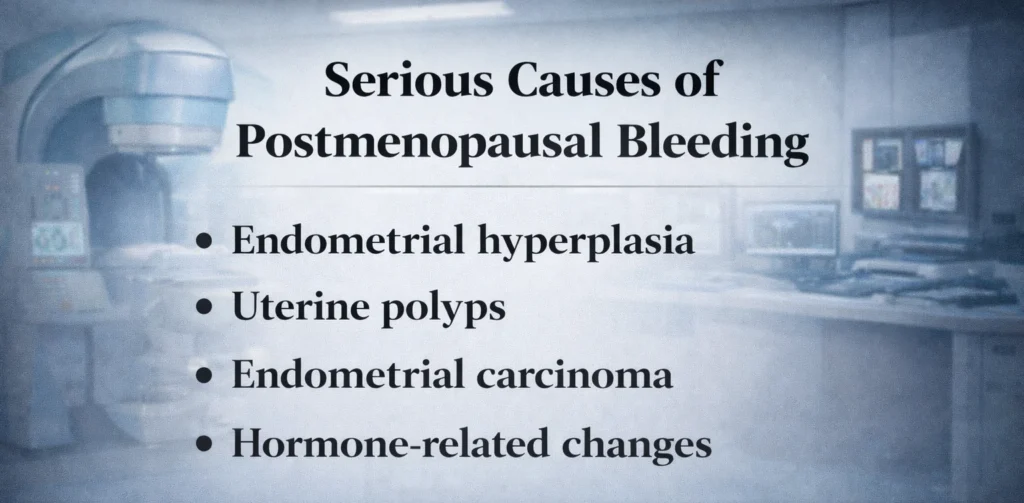
Doctors prioritise ruling out cancer when evaluating bleeding after menopause because delayed diagnosis worsens outcomes significantly.
Among all bleeding after menopause causes, malignancy is the first concern clinicians must exclude.
| Cause category | Why it matters |
| Endometrial hyperplasia | Pre-cancerous condition |
| Uterine polyps | Can hide malignant cells |
| Endometrial carcinoma | Most common gynaecological cancer post-menopause |
| Hormone-related changes | Rare but monitored |
The most dangerous mistake is assuming benign causes without investigation. This is why referral to a uterine cancer doctor in Kolkata becomes essential the moment bleeding appears.
Postmenopausal Bleeding in Indian Women: Evaluating the Cancer Risk
Around 10 % of women with postmenopausal bleeding are diagnosed with uterine cancer, with a higher risk after age 55.
The postmenopausal bleeding cancer risk is not theoretical
It is measurable and significant, especially in India, where symptoms are often ignored.
Risk increases if you have:
- Diabetes or obesity
- Late menopause
- History of hormonal imbalance
- Family history of uterine or ovarian cancer
Many women feel well otherwise, which creates dangerous reassurance. Cancer of the uterus often presents with bleeding alone, long before pain or weight loss.
This is precisely where an experienced uterine cancer doctor in Kolkata can intercept the disease early, when outcomes are best.
Early endometrial cancer symptoms you should never dismiss.
The most common and sometimes only early symptom of endometrial cancer is bleeding after menopause.
Endometrial cancer symptoms are often subtle and misleading
They include:
- Spotting or light bleeding months or years after menopause
- Sudden heavy flow without pain
- Blood-stained discharge
- Pelvic heaviness in later stages
| Symptom | What it signals |
| Light spotting | Early mucosal disruption |
| Heavy bleeding | Advanced tissue involvement |
| Discharge | Necrotic or infected tumour tissue |
Because pain appears late, waiting for discomfort delays diagnosis. Early consultation changes survival curves dramatically.
Bleeding After Menopause: When Specialist Evaluation Is Needed
You should see a gynaecologist immediately after any episode of bleeding following menopause, even if it happens once.
To Further Clarify: When to see a gynaecologist after menopause
Do not wait if:
- Bleeding lasts more than one day
- It recurs after stopping
- Flow is heavy or clot-filled
- There is associated fatigue or weakness
Early evaluation allows quick referral to a uterine cancer doctor in Kolkata if malignancy is suspected, avoiding unnecessary delays.
Treatment Decisions After Diagnosing Postmenopausal Bleeding
Menopause bleeding treatment depends entirely on the cause, confirmed through imaging and biopsy, not symptoms alone.
Menopause bleeding treatment follows a structured pathway
For your reference, see the information below
- Pelvic ultrasound to assess the uterine lining
- Endometrial biopsy for tissue diagnosis
- Staging scans if cancer is detected
| Diagnosis | Treatment approach |
| Benign polyp | Surgical removal |
| Hyperplasia | Hormonal or surgical therapy |
| Confirmed cancer | Surgery, radiation, or combined care |
Radiation therapy plays a crucial role in uterine cancer management, especially for patients who cannot undergo surgery or require post-operative control, an area where Dr Mukti Mukherjee’s expertise becomes vital.
Radiation Therapy: A Key Pillar in Uterine Cancer Treatment

Radiation therapy reduces recurrence risk and controls disease when surgery alone is insufficient or unsafe.
Radiation oncology is not a backup plan
It is a cornerstone of treatment for many uterine cancer patients.
Radiation helps by:
- Destroying microscopic residual disease
- Treating inoperable tumours
- Reducing local recurrence
- Improving long-term survival
A multidisciplinary approach led by Dr Mukti Mukherjee, an experienced uterine cancer doctor in Kolkata and a radiation oncologist, ensures precision and safe care.
Ignoring Bleeding After Menopause Can Cost More Than Time
Delaying evaluation of postmenopausal bleeding shifts cancer from a curable stage to a life-altering one.
But uterine cancer does not wait
What could have been treated early becomes complex, requiring aggressive therapy and longer recovery.
Women often delay care because:
- Bleeding stops on its own
- There is no pain
- Family responsibilities take priority
Every experienced uterine cancer doctor in Kolkata will tell you this truth plainly: time lost is prognosis lost.
Final Verdict - Act on Warning Signs Before They Escalate
Bleeding after menopause is not a minor issue, not a waiting game, and never normal. It is the body’s clearest warning that something needs attention now.
Early evaluation by a trusted uterine cancer doctor in Kolkata, supported by expert radiation oncology care from Dr Mukti Mukherjee, can protect not just years of life but also the quality of life.
If bleeding has occurred even once, don’t contemplate. Book a consultation today.
People Also Ask
What is abnormal bleeding after menopause?
Abnormal bleeding after menopause is any vaginal bleeding, spotting, or blood-stained discharge that occurs 12 months or more after periods have completely stopped.
After menopause, the uterine lining should remain inactive. Any bleeding indicates underlying pathology and requires medical evaluation.
How long can postmenopausal bleeding last?
Postmenopausal bleeding should not last at all. Even bleeding that occurs once or stops within a day is considered abnormal.
Duration does not determine severity. A single episode can signal serious conditions, including uterine cancer, and must be investigated.
Does postmenopausal bleeding feel like a period?
Postmenopausal bleeding does not usually feel like a normal period and often occurs without cramps, hormonal symptoms, or cycle patterns.
It may appear as spotting, sudden heavy flow, or irregular bleeding, which is why many women underestimate its seriousness.
Can progesterone cause bleeding after menopause?
Yes. Progesterone therapy can cause bleeding after menopause, but this is never assumed to be harmless without proper evaluation.
Any bleeding while on progesterone still requires investigation to rule out endometrial abnormalities or cancer before attributing it to the medication.